Sunday, June 30, 2013

Update to "Just" and "Only"


Therefore, I think it’s only right that I clarify. There are instances when the words are justified, and in fact encouraged when relating to running.

And I would like to thank my friends for pointing out these great examples. If you have others, please feel free to add them to the comments section at the bottom.

Here are a few of my favorites I heard:

·      I just ran a marathon, so I’m going to eat an entire pizza.
·      A 5K is just over three miles.
·      I am only eating cheeseburgers and drinking beer, because I just did an Ironman.

Those are perfectly acceptable exceptions to the rule.

On the other hand, the worst usage in the history of running came from Ben Reeves yesterday, when he uttered the words, “Just Leadville.” For those of you that don’t know, when a runner says “Leadville,” he is generally referring to a 100-mile torcher-fest that starts at 9,200 feet of elevation and climbs as high as 12,600, and of course I’m not talking about a single climb. There may be tougher races out there, but there certainly aren’t a lot of them. No matter what, the original rule should never be broken when referring to Leadville. In Ben’s defense, I think the question that led to that was something like, “What races do you have coming up?” So, it may be in the gray area.

If you have any other exceptions and/or terrible violations, I want to hear them.

Thursday, June 27, 2013

Please Stop Using "Just" and "Only"


I’m on a crusade to outlaw the words “only” and “just” from the vocabulary of every runner.

I hear it all the time, and the words just don’t work.

Go to a race expo sometime and ask 10 people if they’re running. I’d put money down that at least half will slump their shoulders and say something like, “I’m just doing the half.”

On almost every Saturday, I hear a fellow member of Runner’s Edge of the Rockies say something like, “I’m only going 14 miles today.” I’ve heard the same thing for 16 and 18 miles, too. For some reason, people stop using it when they hit the 20-mile plateau. Of course, that’s also when people will literally run an extra 10 feet because their Garmin watch says, “19.97 miles,” and they must eclipse 20.

My guess is that half the people reading this blog are runners, and they’re thinking, “Yep. That sounds about right.”

The other half only run when evil clowns are chasing them, and they’re thinking, “You’ve got to be (fill in the blank) kidding me. Do people actually think that?

First things first. Nobody ever runs JUST a half marathon. According to Running USA, 1.85 million people crossed the finish line of American half marathons last year. That’s a lot of people. In fact, it’s a 284 percent increase since 2000. An impressive number.

However, there are 315.9 million people in the United States. That means if nobody ran more than one half marathon in 2012 (a ridiculous assumption because those that run one tend to run at least a few, but play along with me), only 0.59 percent of the population accomplished the feat last year.

As for ONLY going 14-18 miles on a training run, I think it’s a considerably less ridiculous assumption to say that people who run that far are probably training for a marathon or ultramarathon.

There were less than 500,000 marathon finishers in the U.S. last year, putting us at 0.15 percent of the American population (again, assuming no repeat runners).

It’s time to stop apologizing. It’s time for people to accept responsibility for what they’re doing.

You’re running a half marathon? Say it proudly.

You’re training for a marathon? Say it loud. Own it.

Here’s the thing, though. I don’t want this rule to apply only to those who run 13.1 or 26.2.

Anyone who gets up off the sofa and heads to the streets or the treadmill should accept the rule, as well.

You’re running a mile for the first time in your life? Good for you. I hope you enjoy it.

Other runners don’t care how far you’re going. Keep your head up out there, and wave or give a head nod when you pass a fellow runner.

We really aren’t judging you. Most of us are just happy to see you out there, and we’re only cheering for you.

And maybe we’ll see you at the starting line someday soon.


Sunday, June 23, 2013

2013 Sunburst Marathon


“Here’s your bib. The timing chip is attached. Keep an eye on our social media in case the race is cancelled.”

“Thanks. Wait. What?”

I was in South Bend, Ind., and the weather looked perfectly clear. But the forecast apparently was calling for a 95 percent chance of rain, and tornados were touching down throughout the Midwest.

It’s a strange feeling, mostly nervousness mixed with a significant amount of guilt. I was watching CNN, as the good people of Oklahoma were being attacked by another round of tornados. I mean, seriously, was I really worried that a marathon might be cancelled when people were facing life and death?

But of course I was.

This is one of those marathons where I thought I had people convinced to join me, but when it came down to it, everyone else bailed. I flew to Chicago, where I got to see my good friends Brandon and Betsy for the first time in several years.

I drove from Chicago to South Bend, arriving in the early afternoon. My brother went to law school at Notre Dame, and I’d been to visit a few times. Let’s just say I wasn’t expecting a whole lot from the course. Outside the campus, which is pretty amazing, I didn’t remember South Bend being overly scenic. On top of that, all the reviews I’d read talked about the extreme heat every year (an Indiana marathon in June isn’t necessarily a good idea).

What a surprise I was in for.

I stayed at the hotel directly across the street from the starting line. It’s a nicety I’ve experienced a few times, and I always love it. Non-runners might not appreciate it, but avoiding the port-a-potties at the start of a race is a real luxury.

It came in extra handy this time. When I went to check my gear bag (we were finishing a few miles away from the start, and I always want a dry shirt to change into after a race), I realized I had forgotten my gels.

For those of you that don’t know, a gel (aka – a Gu, Clif Shot, Carboom,…) is basically an energy food substance that they pack into this pouch that fits easily in your pocket. Every runner uses at least a few of them during a marathon. And almost every one of us truly hates the damn things. Imagine trying to drink melted gummy bears, and you’ve probably got the picture.

Anyway, during a marathon, you burn so many calories that you really need to replace them somehow, and gels are the most common way. It was only seven minutes from 6 a.m., when the gun was supposed to go off, but I decided it was worth the risk. I ran back to my room, grabbed my gels and made it back to the starting line just as the national anthem started.

I was relieved until the gun went off. That’s when I realized I forgot my electrolyte tablets, which I use every time I go 20 or more miles because they help me avoid cramping up. I pushed the idiotic move out of my head and just focused on running.

As it turned out, the 95 percent chance of thunderstorms left a five percent chance of nothing. And that’s exactly what we got. There were a few drops at the beginning of the race but nothing more, and it felt pretty refreshing and helped me wake up.

As we left “Downtown” South Bend, I saw a woman wearing a Colfax Marathon shirt.

Here’s a warning to those of you that haven’t run a lot of road races. If you wear a shirt from another race, you should expect people to ask you about the race.

When I caught up to the woman and asked her about it, she started laughing because a guy running next to her had done the same thing. It seems that she had not actually run it, but had driven from Virginia to volunteer at it because she was friends with the race director.

The guy, Travis, had run it the year before. The three of us ran together for a while until the woman decided to back off the pace. Travis and I kept running for another 10 miles or so.

I was worried about the course because it was a series of out-and-backs, which I haven’t really liked in past marathons.

In this one, however, the course was absolutely beautiful. Most of the race was run along the St. Joseph River. There weren’t a lot of spectators along the route, but that has never really bothered me. A lot of other runners thing I’m weird for saying this, but one of the reasons I like the smaller marathons is that my fellow runners are generally more willing to talk, which makes the races go by more smoothly for me.

On the final out-and-back, which starts at Mile 11 and turns around at Mile 18, the lead runners started going by me when I was just over halfway through the race. Sometimes seeing a bunch of runners so far in front of me is discouraging, but for whatever reason (it may have been the fact that there weren’t that many in front of me – because it was a smaller race) I found inspiration in the lead runners. They kept their heads down as they went by, and they clearly were running great races, maximizing their energy.

I felt a blister forming on second toe of my left foot (my pointer toe?) about that same time. It’s certainly not unusual to feel something that’s at least moderately uncomfortable during a marathon, but I usually don’t have blister problems.

I kept going, and as I ran along the river, crossed it and headed back the other way (toward the turnaround to go back the exact same way), I found a peacefulness in the water flowing by.

The sun stayed mostly behind the clouds throughout the race, but for about 20 minutes along the river, it shined brightly.

I saw several of the people I had run with earlier go by and cheered them on as they went. I know I’ve said it before, but I’ll repeat it anyway. One of the best parts of a marathon is that almost every runner is competing only within himself/herself. So when a friend (or someone you met a few hours before) is ahead of me, I always have a feeling of joy for them instead of jealousy that they’re beating me. The bottom line in my marathons: the only time I’m upset is when I’m not performing as well as I want to be. It has nothing to do with anyone else.

Coming back, around Mile 19, I passed a guy wearing a pink tutu. He had been close enough for several miles that I heard people talking about him even after he went by. He was running with a sign that said, “I’m running in support of those with MS.” I’m always impressed with those people out there running for a cause.

But I still don’t ever want to get beat by a guy in a pink tutu (that may or may not contradict what I just wrote, but it is what it is).

If you ask any marathon runner about Mile 20, the first thing they usually say is, “The Wall.” It’s the point in the race where most of us feel like a train hits us headfirst. It’s that point where we go from “I feel pretty darn good” to “why did I ever think I could do this?” within about 10 steps.

In my first 24 marathons, I hit the wall somewhere between Miles 20-22 a grand total of 24 times. And possibly it was more like 48-50 times.

In South Bend, though, I found that elusive “runner’s high.” I’ve had it several times in training and a few times in shorter races, like 5Ks, but I’ve never even approached it in a marathon.

I ran past a woman, who said with at least a little snarkiness that only comes after running 22 miles, “How the hell are you running so well this far into the race?”

I told her, “For the first time ever, I found my second wind at Mile 20, and I’m just going to ride it as long as I can.”

She almost smiled, and probably would have if doing so didn’t hurt so badly after running that far, and wished me well.

There is a fairly significant hill at Mile 25 (a simple speed bump at this point in a race is significant, but this one was about a half-mile long), and that’s where the extra energy stopped. I struggled up the hill, put my head down at the top and willed myself to the finish.

The Sunburst Marathon is probably best known for its finish and for good reason.

After about 25.7 miles, we ran onto the campus of Notre Dame, turned across from Touchdown Jesus at Mile 26 and ran down the tunnel onto the field at the Notre Dame Football Stadium. Since it rained the night before, the field was soggy, just like countless games I’ve watched on television.

The finish line itself is right on the 50-yard line.

No, there aren’t 80,000 people screaming as you enter, but it’s still a pretty awesome feeling to enter a stadium with so much history and tradition (I really don’t think it matters whether you’re a Norte Dame fan or not).

It was far from my fastest time, but I was really pleased with it. The course was nice, the volunteers were nicer and the weather cooperated fully.

I drove back to Chicago and got to spend more time with Brandon and Betsy (and their son Connor, who was celebrating his second birthday).

I’m always a little hesitant about going on marathon trips alone, but it always seems to turn out wonderfully.

Marathon No. 25 – and State No. 24 – is in the books.

And I’m thankful for everyone in South Bend (and Chicago) who made the trip great.

Monday, June 10, 2013

InVinceable

This blog has taken awhile. I've started and stopped several times. I wasn’t even sure I should write it because I feel like it’s not my story to write.

But the more people that learn about Vince DiCroce (visit http://andsoitbeginsagain.com to read his blog – and you should read his blog) and his courageous battle brain cancer, the more his story and his fight can inspire people like it has inspired me.


Vince had pacers for the race, but I'm pretty sure
he paced them more than the other way around.
I met Vince in 2006 when I first started with Runners Edge of the Rockies. He was fast, much faster than me. Sometimes he slowed down enough for me to run a mile or two with him, and he always had time to talk after runs for guidance or motivation.

At the time, I had never run a marathon. In fact, I don’t think I had run more than about seven miles.

Vince had run dozens of marathons, and soon after I met him, he completed his first of seven Ironman competitions. I didn’t know it at the time, but 29 of Vince’s marathons and all of his Ironman triathlons have come since he was diagnosed with brain cancer in 2004.

He never mentioned it to me, and clearly he did not let it define him. Over time, the tumor shrunk, and so did Vince’s race times.

Last November, Vince set a PR in every race he ran, including a blistering 3:03 at the Richmond Marathon.

But three days later, during a physical, doctors discovered that the tumors had returned. I’m not going to go into detail because he does so very well in his own blog, http://andsoitbeginsagain.com, which I highly recommend reading and following.

Vince writes very well about the biggest battle of his life. He wrote, “My friends in my running group (Runners Edge of the Rockies) are still in disbelief about the 3:03 and wondering how soon I will break that 3:00 barrier. Soon enough they will know that I am not Superman.”

Superman is the appropriate descriptor for Vince.

Many of us were shocked to learn about the diagnosis, but few of us were surprised to see Vince back out with us cranking out miles on Saturday mornings after he finished his first round of radiation.

Someone started a “Run with Vince” program, meant to encourage people to run a distance in the Colfax Marathon that was beyond their comfort zones. You know, if Vince can sign up for his first Ironman before he had ever done a triathlon of any distance, surely other people could go out and run a 10-miler, half marathon or even a marathon.

As the weeks went by earlier this year, I was fortunate to run with Vince three or four times during Saturday morning training runs, and it wasn’t long before I started questioning whether I could keep up with him.

I asked if he was planning to run any part of the Colfax Marathon, and he said he was thinking about doing the half. I encouraged him, but I had a sneaking suspicion he would not be running that race.

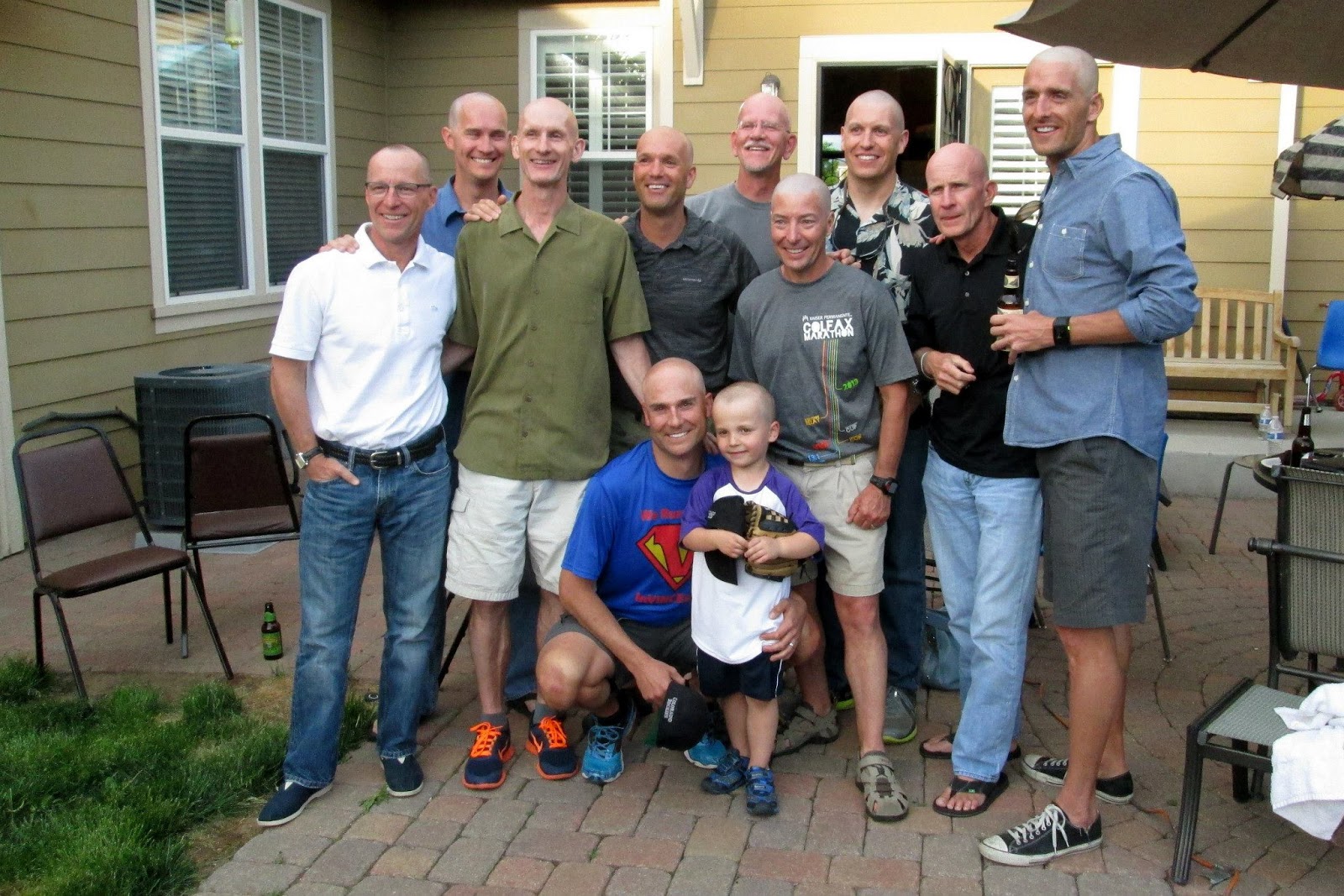
Vince (third from left) inspired a new look for a lot of members
of Runners Edge of the Rockies. This is a few of them.

By that time, about 200 of us had acquired “InVinceable” shirts to wear in support of Vince, and several of us shaved our heads to join Vince in his current look.

A few days before the race, I saw Vince at a party, and he confirmed what I had suspected.

He wasn’t going to run the half. He was going to run the full 26.2 miles, just like his wife and daughter, who both committed to run their first marathons.

On May 19, Vince and seven InVinceables crossed the finish line in 3:56. While it wasn’t the 3:03 he ran six months before, it was one of the most remarkable accomplishments I have ever witnessed. In sports or in life.

Vince may have written that he’s not Superman. I’m still not convinced.

Thursday, May 16, 2013

2013 Shiprock Marathon

I think I’ve mentioned before that one of the hardest parts of trying to run a marathon in all 50 states is convincing people to join me in some obscure race locations. I think I’ve also mentioned that certain people in my running club, Runner’s Edge of the Rockies, are awesomely easy to persuade.

I’d had a few people tell me that they’re favorite race was one in New Mexico that almost no one had ever heard of. Each time, the runner hesitated just a moment, as if they were deciding whether to keep it a secret. But each time, they told me about a race in the middle of a Navajo reservation near the Four Corners called the Shiprock Marathon.

The drive was going to be about seven hours, and I approached a few people I knew that preferred small races and weren’t afraid to travel. Jim Turosak, who had gone to St. George with me in October (before an extended break while trying to let my calves fully heal), was pretty easy to convince. Once he confirmed, I didn’t really worry about putting the full court press on anyone else.

Apparently, I didn’t have to. By the time we left on that Friday morning, Steve McAnnally (who had done Green Bay with me), Nason Newberg (Vermont City), Andy Hartman (a two-time veteran of the ridiculous Leadville Trail 100) and Kristin Furfari, Andy’s girlfriend who is on a quest to run a marathon each month this year (and could beat the tar out of the rest of us without trying), all joined Jim and me in a rented Suburban, and we headed southwest on Highway 285.

Trying to describe the six styles of humor in the car would be impossible, but if you remember Comic Relief and how they would put comedians with completely different styles back-to-back-to-back, you’ve got a pretty good idea. Each style was unique, but all of them blended together flawlessly. Let’s just say, I really didn’t stop laughing for at least 48 hours.

Andy Hartman ran the brutal Lead Man race series
two years ago. Clearly he knows how to carbo-load.
A little over an hour into the drive, near Buena Vista, Colo., we pulled into a gas station to use the facilities. Jim and I took the opportunity to buy a few lottery tickets, figuring only people in sparse outlying towns ever won. Our tickets were nearly as impressive as winning tickets would have been. We didn’t match a single number on any of them. 

We knew we were going to drive to Pagosa Springs, Colo., after the race, but it also provided the perfect stopping point for lunch on Friday. None of us were too concerned about having great races the next day, as our lunch orders proved. Of course, most of us weren’t as daring as Andy, who ordered some concoction with a hamburger floating in a bowl of green chili.

When we finally made it to Shiprock, N.M., we realized that the campus at Dine College, where the Expo (and bus pickup the next day) was located, was not an option on the iPhone map app or car’s GPS. Fortunately, we kind of ran into it on accident. Of course, in a town of about 8,000 people it’s not too tough to find anything. After picking up our packets and exploring every bit of the 2-3 tables in the expo, we decided to visit the Four Corners monument about 20 minutes away. There’s something to being at the only place where four states border each other. I’m still not sure what that something is, but it is something. We took the requisite photos standing in all four states, playing Twister (“right hand in New Mexico, left foot in Utah,…”) and, well, there really aren’t any other pictures to take. Or things to do there, for that matter.

This is the expo and finish area
So we left for Farmington. It’s about 30 miles from Shiprock, but since there are no hotels in Shiprock, it was really our only choice. It made for a long morning before the race because we had to drive back to Shiprock, where we caught a school bus to the starting line, which was so close to the Arizona border that half our bus actually ended up in Arizona when we turned around.

If you like to hang around the starting line for an hour or two, this may not be the race for you. We were there just long enough to hit the port-a-potty (side note: when I was growing up in Kansas City, we referred to these things by the local company’s name: Johnny On The Spot. I still like that name better than anything that uses the word “potty.”) I was in the middle of stretching when I heard, “Go” or some variation of “It’s time to start.”

I ran with Andy and Jim for a about a mile or two, before I realized that they were clearly going to run much faster than I should even attempt. I hadn’t run more than 16 miles since St. George on Oct. 6, so this was going to be more of a training run, meaning that if I made it 20-22 miles and had to walk the rest, I was good with that.

As I watched them stride into the distance, I looked to my left and saw a woman hurling on the side of the road. We weren’t even three miles in, and I was hopeful that she was running the first leg of the relay – most runners out there were doing the relay – because otherwise she was starting a very, very bad day. I also hoped it wasn’t an omen for me.

Only six miles into the race, I found myself all alone. I’ve run some small races, but that had never happened so soon. A few miles later, I started talking to a man with a Southern accent. He was running his 93rd marathon, and he was on state No. 46. I’m pretty sure I’ve said before that I don’t run races with headphones on because I find it easier to run when I can talk to people for a while. I really enjoyed talking to this guy from Alabama, and I asked his name. “Forrest,” he said. I started laughing and asked for clarification, “Wait, I’m running across the desert with a guy from Alabama named Forrest?” He, of course, had had this reaction before and quickly verified that when his kids cheered for him, they screamed, “Run Forrest. Run.”

After parting ways with Forrest, I caught up with Tara Klima, another friend from Runner’s Edge who had made the trip down with another friend. Tara was with another woman from the Denver area named Hoa, who she happened to meet during the race (Denver runners tend to migrate toward each other, it seems).

The course itself isn’t the kind that give you a lot of variety. It’s definitely the desert, but the Shiprock itself and the wall that leads to it are pretty amazing. Like St. George, when the sun hits the rocks in this area just right, they glow a beautiful red. I was a little concerned that we would be staring at the Shiprock during the entire race, which can be frustrating because it seems like you’re never getting closer, like the bridge at Outer Banks. With this race, though, you could really only see the area’s most dominating landmark for 7-8 miles, as long as you weren’t looking back over your shoulder. It was just long enough to really enjoy it, and at Mile 14 we passed the wall and wouldn’t really see much of it again until the final few miles.

Kristin ended up catching up to Tara, Hoa and I, and we rattled off a few miles together. At points, I ran alone with each of them, including an extended stretch with Tara, who I had not run with much in the past, even though we are in the same running group.

I wasn’t trying to run my normal race pace, which might explain why I was genuinely enjoying the course. It was just like our average Saturday morning runs, except we were in a completely unique setting. The volunteers at each aid station were phenomenal. I felt bad for a kid who was clearly disappointed because not many people were taking the cut up energy bars he was offering. He obviously wanted to help but didn’t realize that he was, even if only a few people were eating the energy bars. I’m pretty sure the few people who did take them needed them and really appreciated that they were available. The bottom line is that if there are volunteers at aid stations that feel like they’re not doing enough, the race organizers did their job very well. That was the case at Shiprock, and the race director should be commended.

Nason Newberg and Jim Turosak know what it's like
to place in their age groups. I do not.
At Mile 22, my body immediately reminded me about the promise I’d made to myself. I went from feeling strong to feeling like a truck hit me. I started walking, at which point I saw Tara and Steve both fly by. Kristin reached me and said the marathon she had run two weeks before was really hitting her. But I think it’s just because she is really nice that she agreed to walk the next three miles with me. We ran most of the final mile, including the last quarter mile through sandy, desert dirt (the only questionable part of the entire course, but I honestly didn’t mind).

We crossed the line at just over 4:30. Nason, who wasn’t wearing a watch and wouldn’t know his time for at least 24 hours, won his age group, and Jim got second in his age group despite re-injuring his calf a few miles into the race. Both won Navajo pottery as trophies. All of us finished and were happy enough with our performances, so we hit the road toward Pagosa Springs, where Andy promised the natural hot springs and cold beverages provided magical healing powers.

I don’t know about those healing powers, but I do know a great dinner and a million laughs did help.

Andy summed up the weekend nicely on the way home, when he said*, “You know what hurts the worst right now? My abs. I don’t think I’m used to laughing this much.” 

Epilogue: On the way out of Pagosa Springs, we had to go over Wolf Creek Pass, which you may recognize from the song of the same name by C.W. McCall. Well, Andy sang/chanted an outstanding version of that song as we traveled that route. I filmed it but as a favor to him, I’ve decided not to post it here. So you’ll just have to enjoy the original version.


On second thought, I just can't resist. Note: Andy's rule was that everyone had to make chicken sounds throughout the song if we wanted him to continue. I'm not totally sure what kind of chickens some of these people have encountered, but I'm sure they sound exactly like this. Enjoy.


*Editor's note: There is debate on who actually uttered this line. Andy claims it was Steve.

Tuesday, May 14, 2013

2012 St. George Marathon

If you don’t work in sports, you might not realize just how difficult it is to do anything during the season that isn’t actually related to the season.

I started writing this in October, but basketball got in the way. So did lacrosse. Really, a lot of sports got in the way. That’s my excuse, whether you like it or not.

However, it’s time to finish and post this one, because it was a great race.
-------------------------

Has anyone ever told you a marathon was easy? If so, they were lying.

I’d heard so many great things about the St. George Marathon that I was really excited to run it. It seemed like everyone I knew set a PR on the downhill course.

I’ve run some races with significant elevation loss from start to finish, but a few days before I checked out the stats:

  • Pocatello Marathon – 1,550 elevation loss
  • Tucson Marathon (My PR) – 2,200 elevation loss
  • St. George Marathon – 2,560 elevation loss
Holy smokes. I know the math is pretty obvious, but that’s nearly 100 feet per mile. And, surprisingly, there are some uphills out there, which means the downhills are even steeper.

It took me nearly two weeks to write this blog because, frankly, I’ve been too sore to think about it. Since the first marathon I ran, no race has come close to beating me up quite so much. Usually, I can head out for an easy run a few days after a marathon. This time, I couldn’t tackle stairs for nearly a week after the race.

But, man, what a race. When you think of the “great” marathons that require time qualifications (Boston) or lotteries (New York), nonrunners might be surprised that a little out-of-the-way town in Southern Utah is a marathon favorite.

To register for the St. George Marathon, you have to enter a lottery. The previous two times I’ve tried, I did not get in, including one year when just about everyone in my running group got in except for me (or at least that’s the way it seemed). I really didn’t expect to get in this year, which is why I wasn’t too worried when I found out my friend was getting married in Denver that same day. Oops.

I got in and found out my friend Jim Turosak also got in, and we quickly made plans to travel to the race together. Jim and I traveled to the Pocatello Marathon in 2009, when an injury forced me to bail on the full and run the half instead, so I knew that he would keep me entertained throughout the trip.

We flew to Las Vegas on Friday. It’s funny how weird things become normal after running as many races as I have. I love eating a huge breakfast the day before a marathon, and I don’t care if it’s in the morning or at lunchtime. We landed in Vegas, got the car and I drove us straight to a restaurant I’d found on Yelp. Jim looked a little concerned when I pulled into the parking lot, but I knew there were healthy sandwiches on the menu, if he wanted them. After we sat down and looked at the menu, there would be no sandwiches ordered. I got eggs and bacon with potatoes and an English muffin, and Jim got something else that would make most runners cringe.

The drive to St. George is about two hours and makes a quick cut through Arizona (20 miles or so) before hitting Utah. Because Jim had never been to Arizona before, it sparked the debate about what constitutes “visiting” a state. I’ve always thought it requires a night’s stay. Jim said all it takes a “substantial event,” such as a meal or bathroom break. Regardless, we kept driving, so Jim still can’t claim to have visited Arizona.

Jim Turosak and I before the 2012 St. George Marathon
You have to wake up really early for this race. Buses depart for the start between 4-5:30 a.m. It’s a long drive (roughly 26.2 miles) through the dark, and when we reached the starting area, it was cold. St. George is known as one of the best-organized races in the world, and when we got to the top, we realized why. As we got off the bus, each runner was handed a Mylar (space) blanket. This is a little race trick I figured out a few years ago. At the end of each race, most runners throw away the foil-like blanket they’re given at the finish. But I realized they are absolutely perfect for those times you have to wait around for a race to begin, so I generally throw mine in my gear bag for the next time. St. George’s organizers apparently knew this already.

That wasn’t the best way they tried to keep us warm, though. They set up a series of campfires, and they lit each one as soon as enough people were surrounding it. I’ve seen campfires at a few races over the years, but there was something special about these. Everyone was chatting and making new friends with the people around the fire. As the flames were waning, the call went out to head to the starting line.

The first 5-6 miles were in the dark, and we had to trust that the roads were in good shape because none of us could see much. We just followed the people in front of us. There was a strange calm to it, despite being amidst a few thousand people running down desert roads. Jim and I kept a conservative pace early until he finally broke off about seven or eight miles in. He’s a great downhill runner, so I knew he was going to fly, just as he did in Pocatello where he got a PR and a trophy for second in his age group.

I settled in, hoping to just enjoy the race. As the sun came up, the rocks all around us turned a magical red. I live in Denver, so I can drive 25 minutes to Morrison and visit Red Rocks Park, but that close proximity has never diminished my awe when the sun hits rocks like that just right. In college, I visited Uluru (or Ayres Rock) in the Australian Outback, just so I could see the red glow during sunrise and sunset. As I ran through the outskirts of St. George, I got to enjoy that glow all around me for nearly an hour of my run.

So far, the race organization had been very good, but I soon realized just how good it was. At every aid station, and there were a ton of them, they offered the standard water and Gatorade. Like a lot of races, they also had Vaseline, just in case you might be chaffing in various parts of your body. But then there was something I had never seen. At each aid station, 2-3 people in rubber gloves were rubbing Icy Hot on runners’ legs. At first I thought it was a little strange, but by Mile 16, I decided it was genius. I stopped and a nice woman helped me out. She made a point of saying that I the reason they rubbed it in for us was so we wouldn’t accidentally rub it in our eyes later. There’s no doubt that if I was left to apply it myself, I probably would have rubbed it in my eyes, in my hair and in my mouth. Yes, I become a moron when running (others might argue it’s not limited to running), so I’m glad the St. George Marathon organizers were thinking for me.

My legs were throbbing from all the downhill, so as usual I looked around for someone to talk to. I struck up a conversation with a woman and started running with her. It seemed like everyone on the course knew her. As it turned out, they very well could have. Debbie Zockoll has run the St. George Marathon all 36 times since it was founded. Yes, you read that right. And running with her for a while was nice because I could pretend all the people were cheering for me (they were not).

The final couple of miles though town were sunny, making them a little more challenging than they always are anyway, but the crowds were great yelling encouragement and making them as fun as they could be.

After a rough stretch of finishes, I finally broke the four-hour mark again with a 3:49. I was happy. Jim was even happier after turning in a solid 3:21. We jumped in the car, headed back to the hotel for quick showers and hauled it back to Vegas for our flight. I arrived back in Denver with just enough time to stop at my house for a change of clothes, and I made the wedding with about 20 minutes to spare. Sitting still at the ceremony and reception without falling asleep was tough, but I somehow pulled it off, making it a truly great day.
I hurt so bad right after this race that I couldn't even
take my awesomely nerdy compression socks off.

Tuesday, December 25, 2012

Christmas Traditions


The blog has been on hiatus for a while. What can I say? Sometimes life and work get in the way. But Christmas seemed like a good time for a new entry.

I like Christmas traditions. And the Kennedys have a lot of them. Some happen every year, and others only when all three brothers can get together. For example, Darren, David and I are allowed to buy each other gifts beginning on Dec. 26. When we’re together, we load into the car and head out to the after-Christmas sales. It’s especially strange, since all three of us detest shopping, especially when it’s crowded. In fact, it might be the only time each year you might catch me in a store instead of ordering everything online.

There was a report from Cairo, Egypt, where Darren and his family live, that my youngest nephew continued another Kennedy tradition, proclaiming, "This is the BEST Phineas-and-Ferb-holiday-pack um, thingamabob, EVER!" You see, no matter what the gift, it’s ALWAYS the best ever. My brother once shouted from the rooftops, “This is the BEST Preparation H EVER.” The neighbors asked him to get down from the roof and quiet down immediately.

Traditions are harder to keep these days. Part of the family is across the world, and my parents now spend the winters in Arizona instead of Kansas City, where we grew up and David still lives with his son.

So, sometimes new traditions need to be formed, and six years ago on Christmas morning I headed out for a little run on the Charouleau Gap, a trail in the mountains just north of Tucson. It’s meant for ATVs, mostly, but I liked the challenge. I’ve run it every Christmas since, usually trying to go farther up than the year before. And I do mean up, because the trail, as the name suggests, rises toward a gap between two mountains. Lately, I’ve been nursing an injured calf, so I knew I was unlikely to go farther than last year’s run of 10-11 miles. It’s not exactly ideal for running, with loose rocks scattered on every switchback, and today’s run was cut extra short by one of those rocks, which I stepped on wrong and rolled my right ankle (an injury I have only slightly more often than calf tears).

That first year, I also encountered a bull in the middle of the trail on my way back down. It stopped me in my tracks, as I tried to figure out the best move. It occurred to me that all that land is free range, and the bull stared at me with no indication that he might charge. I wished him a Merry Christmas. He said “moo” – or maybe it was “keep moooving.” I’m really not sure. I was a little surprised to see him in the exact same spot the next year. And the next. Six years later, I was disappointed to approach the spot and find it empty. Hopefully the old boy was sleeping in. I did, however, run across three deer at the trailhead.

Despite the gimpy ankle, I made it back without too much trouble. Now it’s time to open a few gifts and see what Santa left in my stocking (which most years includes an annex – or grocery bag filled with more stuff).

I’m pretty sure they’re going to be the best gifts ever.

Merry Christmas, everybody. And if you don’t celebrate Christmas, I hope you have a wonderful Tuesday.